
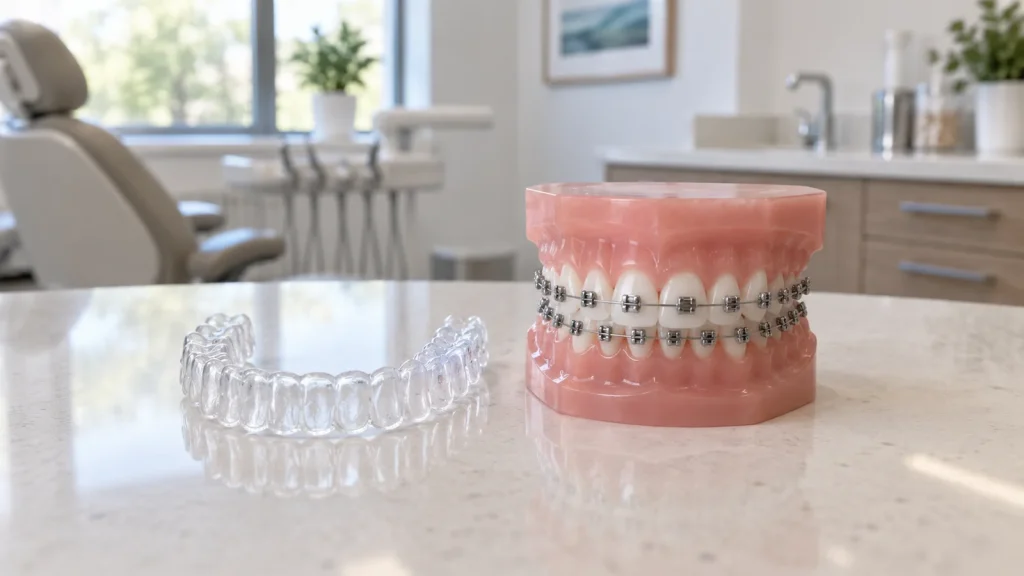
Invisalign clear aligners and traditional braces can both move teeth, but the better fit depends on the orthodontic problem, the movements required, oral health, lifestyle preferences, and the patient’s ability to follow treatment instructions. Neither option is universally better.
Invisalign may suit patients who value a removable, less noticeable appliance and can wear aligners consistently. Braces remain fixed and may give the treating professional different control for certain complex movements or bite relationships. A clinical assessment is needed before choosing between them.
How Are Invisalign and Braces Different?
Invisalign uses a planned sequence of transparent, removable trays that fit over the teeth. Each aligner applies controlled pressure to selected teeth, and patients change to the next aligner according to the treatment plan. Small tooth-coloured attachments or elastics may sometimes be used to support particular movements.
Traditional braces use brackets attached to the teeth and a wire that guides movement. The appliance stays in place throughout active treatment and is adjusted by the treating professional. Braces can be made with different materials, but they remain fixed rather than being removed for meals and cleaning.
The most important difference is not simply how the appliances look. Aligners and braces use different mechanics, create different daily responsibilities, and may not offer the same degree of control for every movement. The diagnosis and treatment goal should guide the choice.
A quick practical comparison:
- Invisalign: removable trays, less noticeable appearance, cleaning outside the mouth, and a strong need for consistent wear
- Braces: fixed brackets and wires, visible hardware, cleaning around the appliance, and no need to remember to reinsert it
- Both: require treatment planning, regular monitoring, good oral hygiene, and retainers after active tooth movement
How Do Appearance and Removability Compare?
Invisalign aligners are transparent and often less noticeable in everyday conversation. They can be removed for eating, drinking anything other than water, brushing, and flossing. That flexibility appeals to many adults and teens, but removability also creates responsibility.
Aligners need to be worn for the schedule prescribed by the treating professional. Frequently leaving them out can reduce the planned force on the teeth and affect progress. Patients must also keep track of the trays, avoid wrapping them in napkins where they can be discarded, and clean them as directed.
Braces remain attached to the teeth. Patients do not need to decide when to wear them or remember to put them back after meals. However, brackets and wires are more visible, and some foods may need to be avoided to reduce the chance of bending a wire or loosening a bracket.
Appearance matters, but it should not outweigh clinical suitability. A less visible appliance is useful only when it can achieve the required movements and the patient can manage it consistently.
Which Option Is Easier to Keep Clean?
Invisalign can make brushing and flossing feel more familiar because the trays come out. Patients still need to clean their teeth before replacing the aligners and keep the trays clean. Wearing aligners over food debris or frequently sipping sugary or acidic drinks with them in place can create oral-health concerns.
Braces require cleaning around brackets, wires, and the gumline. A regular toothbrush may be combined with floss threaders, interdental brushes, or other tools recommended by the dental team. Food can collect around fixed hardware, so careful daily cleaning is essential.
Neither option eliminates the risk of tooth decay or gum inflammation. Before orthodontic treatment begins, active oral-health problems may need to be addressed. During treatment, regular dental care and consistent home hygiene remain important, regardless of the appliance.
Hygiene questions to consider include:
- Can you brush and floss carefully every day?
- Will you clean aligners and your teeth before reinserting the trays?
- Can you adapt your technique to clean around brackets and wires?
- Do you have gum inflammation, cavities, or existing dental work that affects planning?
- Which routine are you realistically more likely to maintain?
How Does Patient Responsibility Differ?
Invisalign depends heavily on patient participation. The aligners work only while they are being worn. Patients must follow the prescribed wear schedule, move through the series as instructed, store the trays safely, maintain hygiene, and attend progress visits.
Removability can be an advantage for meals, sports, photographs, and oral hygiene, but it can become a disadvantage when aligners are regularly forgotten or lost. Teens and adults should consider their routines honestly rather than assuming a removable appliance will automatically be easier.
Braces do not depend on remembering to wear the appliance because it remains fixed. Responsibility shifts toward protecting the brackets and wires, following food guidance, cleaning around the hardware, and contacting the treating office when something breaks or causes concern.
Both approaches require appointments, cooperation, and retention after active treatment. Retainers help maintain the new tooth positions, and wearing them as directed is an important long-term responsibility regardless of whether treatment used aligners or braces.
Are Braces Better for More Complex Cases?
Braces may be recommended for some complex tooth movements or bite relationships because fixed hardware gives the clinician different ways to apply force and control movement. Invisalign can also address many involved cases, sometimes with attachments, elastics, or refinements, but it is not suitable for every orthodontic problem.
Complexity can involve more than visibly crooked teeth. The clinician may need to consider:
- Significant tooth rotations or teeth that need substantial vertical movement
- The position of tooth roots within the supporting bone
- Severe crowding or large spacing
- Overbite, underbite, crossbite, or open-bite relationships
- Missing teeth, impacted teeth, or teeth that have not erupted normally
- Jaw growth or skeletal relationships that tooth movement alone may not resolve
- Existing crowns, bridges, implants, or periodontal concerns
The label “complex” does not automatically rule Invisalign in or out. Digital planning may show that aligners can reasonably manage the necessary movements, or it may reveal that braces, combined treatment, or assessment by another dental professional is more appropriate. The recommendation should be explained in terms of the specific movements required.
How Is Invisalign Suitability Assessed?
Invisalign suitability is assessed through an examination and diagnostic records, not by age or appearance alone. The clinician reviews the patient’s concerns, dental and medical history, oral health, tooth positions, bite, jaw relationships, and treatment goals.
The assessment may include digital scans or impressions, photographs, and dental imaging when clinically appropriate. These records help the clinician evaluate the starting positions of the teeth and plan how they may move. They can also reveal concerns that are not obvious in a selfie or mirror.
A comprehensive assessment considers:
- Whether the teeth and gums are healthy enough for orthodontic movement
- Which teeth need to move and in what direction
- Whether aligners can control those movements predictably
- How the upper and lower teeth meet
- Whether attachments, elastics, space management, or another technique may be needed
- Whether the patient can wear and care for aligners consistently
- The patient’s priorities, limitations, and expectations
Digital simulations can help illustrate a proposed plan, but they are not guarantees of an exact result. Teeth respond biologically, and refinements or adjustments may be needed. Ask what the treatment aims to improve, what it may not change, and how progress will be evaluated.
DSK Dental offers Invisalign in Bayview Village and requires an assessment to determine suitability. The clinic’s broader dental services in North York may also be relevant when oral health or existing dental work needs to be considered before clear-aligner treatment.
Is Invisalign as effective as braces?
Invisalign can be effective for many alignment and bite concerns when it is clinically appropriate and worn as directed. Braces may offer advantages for some complex movements. Effectiveness depends on the diagnosis, treatment plan, clinician oversight, and patient cooperation.
Is Invisalign more comfortable than braces?
Comfort is individual. Aligners avoid brackets and wires, but tooth movement can still create pressure or tenderness, and aligner edges or attachments may sometimes irritate the mouth. Braces can also cause pressure after adjustments and may rub the cheeks or lips. Neither option can be promised to feel comfortable at all times.
Can adults choose Invisalign instead of braces?
Many adults can be assessed for Invisalign. Age alone does not determine suitability. Oral health, tooth and bite positions, required movements, existing dental work, goals, and consistent aligner wear are more important factors.
Do Invisalign aligners need to be worn all day?
Aligners generally need to be worn for most of the day and removed only as directed for eating, drinking, and oral hygiene. Follow the specific schedule provided by your treating professional rather than relying on a generic number of hours.
How do I know which option is right for me?
Start with a professional assessment. Ask which movements are required, whether Invisalign can control them, what daily responsibilities come with each option, and whether another approach should be considered. The right choice is the one that fits both the clinical problem and your ability to follow the plan.
Talk to DSK Dental About Invisalign in North York
If you are considering clear aligners, contact DSK Dental to arrange an Invisalign consultation. DSK Dental is located in Bayview Village Shopping Centre at 2901 Bayview Avenue in North York.
The dental team can assess your teeth, bite, oral health, and goals and explain whether Invisalign may be appropriate. Because the website does not confirm that DSK Dental provides traditional braces, patients who need another orthodontic approach can ask what next step or referral may be recommended.